
What Is the Science of Reading?
The Science of Reading is the large, converging body of research—drawn from cognitive psychology, linguistics, developmental psychology, and neuroscience—on how the human brain learns to read, and what instruction most reliably produces skilled readers. It is not a program, a curriculum, or a single method. It is the evidence base that good reading curricula are built on. Decades of studies point to a clear conclusion: most children learn to read most efficiently when they are taught the relationship between sounds and print explicitly and systematically, rather than left to infer it on their own.
This page is an overview of that research and the core ideas behind it. Each section links to a deeper resource so you can follow the thread that matters to you—whether that is the cognitive scientist whose work reframed the field, the instructional method the research points toward, or what "evidence-based" actually means when a district evaluates a reading program.
The Simple View of Reading
The Simple View of Reading, introduced by Philip Gough and William Tunmer in 1986, holds that reading comprehension is the product of two separable skills: decoding and language comprehension. Expressed as an equation, Reading = Decoding × Language Comprehension. If either factor is zero, reading comprehension is zero—a child who cannot decode cannot read, no matter how rich their vocabulary, and a child who decodes fluently but lacks language comprehension reads words without understanding them.
The insight underneath the equation is that writing systems were invented to convey language, not meaning directly. Letters on a page act as a kind of transducer that converts speech sounds into visual symbols and back again; the meaning is supplied by the reader. This is why decoding has to be taught: comprehension develops naturally through everyday language exposure, but decoding an alphabetic writing system is a learned skill that almost no child discovers unaided.
Systematic, Explicit Phonics
In 2000, the National Reading Panel reviewed decades of studies and concluded that systematic phonics instruction makes a significantly larger contribution to children's reading growth than unsystematic or non-phonics approaches. Students taught phonics systematically outperformed those taught through whole-language, whole-word, and basal programs. The Panel also found that phonics instruction has the greatest impact when it begins early—in kindergarten or first grade—before children have settled into less reliable strategies like guessing from context.
"Systematic" and "explicit" are the operative words. Systematic means every sound-spelling correspondence is taught in a deliberate sequence, leaving nothing to chance. Explicit means each concept is taught directly and clearly, not discovered incidentally. The research on guided versus minimal-guidance instruction is decisive on this point: learners acquire complex skills more efficiently when the material is presented to them directly, rather than when they are asked to construct or infer it themselves.
Orthographic Mapping and the Self-Teaching Hypothesis
How does a child move from sounding out a word letter by letter to recognizing it instantly? The answer is orthographic mapping—the process by which the brain bonds a word's spelling to its pronunciation and meaning so it can be retrieved at a glance. David Share's self-teaching hypothesis explains the mechanism: each time a child successfully decodes an unfamiliar word, that act of decoding teaches the brain the word's specific spelling. Decoding is the engine that builds the permanent store of instantly recognized words.
This is also why spelling matters as much as reading. Research comparing the two finds that spelling sets up a higher-quality representation in memory, because writing a word forces the learner to attend to every letter in sequence. Reading and spelling are not separate skills to be taught in separate lessons—they are two sides of the same process.
Cognitive Load and How the Brain Learns
Cognitive Load Theory, developed by John Sweller, describes a hard limit on learning: working memory can hold only a small amount of new information at once, and it loses that information within seconds unless it is rehearsed and moved into long-term memory. Anything that crowds working memory with information not essential to the task—extraneous cognitive load—slows learning down.
For reading instruction, the implication is direct. When a program asks children to juggle multiple competing strategies for identifying a word, or surrounds the core task with games, characters, and rewards, it adds a load that has nothing to do with learning the alphabetic code. The most effective instruction strips the task down to one new concept at a time and presents it cleanly. This principle—doing less, but doing it precisely—runs through every part of the research above.
From Research to the Classroom
The research is consistent, but research alone does not teach a child to read—a curriculum does, and not all curricula apply the evidence equally well. The sections below lead to the four areas where the Science of Reading gets specific: the cognitive scientist who synthesized much of it, the instructional method it points toward, the long-running debate over a leading legacy approach, and the standard districts use to judge whether a program is genuinely evidence-based.
Diane McGuinness and the Reading Research
Cognitive psychologist Diane McGuinness argued that English is a reversible code—what is encoded in spelling can be decoded in reading—and that a complete phonics program must teach that code in its entirety, built around the 40+ phonemes of English and their spelling patterns. Her work reframed how the field thinks about teaching the alphabetic code. Read her biography, her key books, and the principles behind her method.
The Sound-to-Print Method
The instruction the research points toward is the Sound-to-Print method (also called Linguistic Phonics and Speech-to-Print): start with the sounds children already produce in speech and show them how those sounds are represented in print, rather than starting with letters and asking children to guess the sounds. This is the inverse of the traditional Print-to-Sound model, and it is the framework CAPIT Reading is built on.
Orton-Gillingham vs Sound-to-Print
Orton-Gillingham, the most widely known legacy reading-intervention approach, follows a Print-to-Sound model that predates much of the modern research base. Our side-by-side comparison looks at what the evidence actually shows about each approach—instructional starting point, cognitive load, support for English learners, and evidence tier—for leaders weighing a switch.
Evidence-Based Reading Instruction
"Evidence-based" is one of the most overused phrases in education. Our guide to evidence-based reading instruction explains what the term means under ESSA's tiers of evidence, why many programs that invoke the Science of Reading fall short of it, and how to evaluate a reading program on the merits.
Frequently Asked Questions
What is the Science of Reading?
The Science of Reading is the converging body of research from cognitive psychology, linguistics, and neuroscience on how children learn to read and which instruction works best. It is an evidence base, not a single program or method.
Is the Science of Reading the same as phonics?
No. Phonics—teaching the relationships between sounds and letters—is one of the most strongly supported findings within the Science of Reading, but the research base is broader, also covering the Simple View of Reading, orthographic mapping, cognitive load, and language comprehension.
What does the Simple View of Reading say?
It holds that reading comprehension is the product of decoding and language comprehension (Reading = Decoding × Language Comprehension). Both are required; if either is absent, reading comprehension does not occur.
Is CAPIT Reading aligned with the Science of Reading?
Yes. CAPIT Reading is a Sound-to-Print phonics curriculum for grades P–5 built directly on this research—systematic and explicit instruction, decoding and encoding together, and a deliberate focus on reducing cognitive load.
Go Deeper
For the full research basis behind CAPIT Reading, including the studies cited above, you can read our complete documentation.
See the research in action. Book a demo to see how CAPIT Reading applies the Science of Reading in P–5 classrooms.

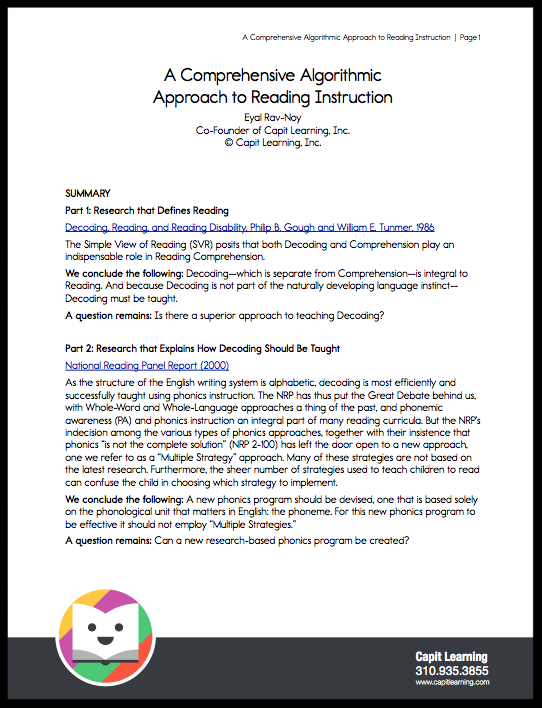
A Comprehensive Algorithmic Approach to Reading Instruction, by Eyal Rav-Noy, Co-Founder of Capit Learning